Welcome to Syndica
Infrastructure that makes Solana applications fast, observable, and secure
Syndica is an enterprise-grade platform that streamlines decentralized application (DApp) development on Solana. From high-performance RPC infrastructure and real-time streaming, to advanced firewall controls and comprehensive observability- the Syndica platform combines a powerful suite of tools into a unified platform designed specifically for Solana, and enables top Solana DApps and protocols to scale their projects with ease.

✓ 10 million free requests every month
✓ Up to 100 requests per second
✓ Get $200 additional welcome credits



Why Syndica
All the features you need, purpose-built for the Solana blockchain

- Low-latency Solana RPC and archive data served from globally distributed bare metal clusters
- Intelligent load balancing, failover, geo-routing and caching for max performance and uptime

Real-Time Streaming
Custom feeds for blockchain events from fault-tolerant, multi-validator infrastructure
- Low latency updates enabled by staked validator connections

Staked Connections
- Send transactions with stake-weighted quality of service (SWQoS)
Intelligent transaction lifecycle management + retry logic to maximize landing speed and success

- Isolate resources and set fine-grained controls on request origins, methods, and rate limits
- Real-time logging and analytics to measure latency, errors, transaction performance and your audience
Getting Started
Start Using RPC
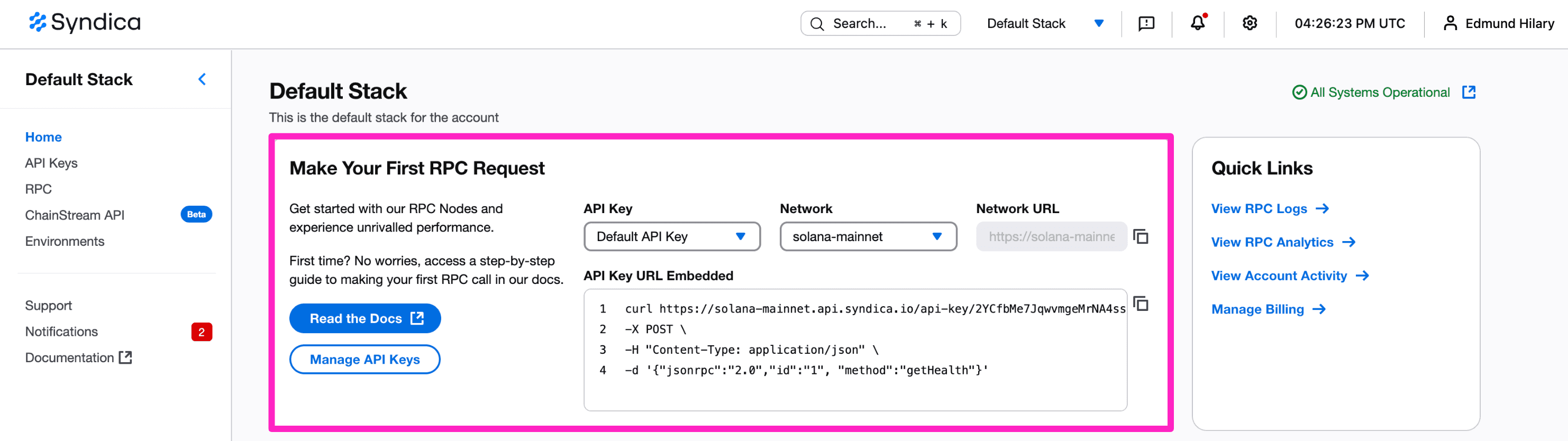
Once registered, you can start making requests for free: simply copy your mainnet or devnet endpoint with your default API key into your project, or see our guide for making your first API call. Syndica automatically routes all RPC calls to our nearest Edge Gateway across four global regions: Northern Virginia (us-east-1), Oregon (us-west-2), London (eu-west-2), and Singapore (ap-southeast-1). Transactions are automatically routed through our custom-built relay infrastructure to the next block producers.
Quick Start Guides:
Start Streaming Data

ChainStream delivers real-time Solana blockchain data including transactions, slots, and blocks through WebSocket subscriptions. ChainStream aggregates data from multiple validators using a "fastest wins" strategy to ensure high availability and redundancy. You can apply custom account filters (all, oneOf, exclude) to target specific events. After setting up your streams, you can monitor active subscriptions, data and message throughput on your analytics dashboard.
Get Started with ChainStream:
Learn About the Platform
The Syndica platform is designed for enterprise teams building production-grade applications. Get the most out of the platform by familiarizing yourself with its basic concepts. Stacks, API Keys, and Observability can be used to organize, secure and gain insight into your applications. Add multiple users and use two-factor authentication to work securely with your team. Learn how billing works on Syndica and how to use custom rate limits and data compression to minimize your latency and costs.

Core Concepts Guides:
Use Advanced Features

Leverage Syndica's advanced features to enable specific request patterns and maximize performance for your application. Configure granular rate limits at the credential level to protect front-end endpoints and allocate usage across services. Enable WebSocket compression to reduce bandwidth by up to 90% for JSON payloads. Use request affinity to route sequential calls to the same node for consistent state views.
Advanced Concepts Guides:
Pricing
Choose the plan that fits your needs
- ✓ 1 GB data / mo
- ✓ 50 WebSockets
- ✓ 1 user
- ✓ 100 Requests / sec
- ✓ 100 GB data / mo
- ✓ 3 users
- ✓ 300 Requests / sec
- ✓ 1 TB+ data / mo
- ✓ ChainStream API
- ✓ Staked Connections
- ✓ Custom limits
- ✓ ChainStream API
- ✓ Staked Connections
- ✓ 99.999% SLA
- ✓ Dedicated support
Stake with Syndica
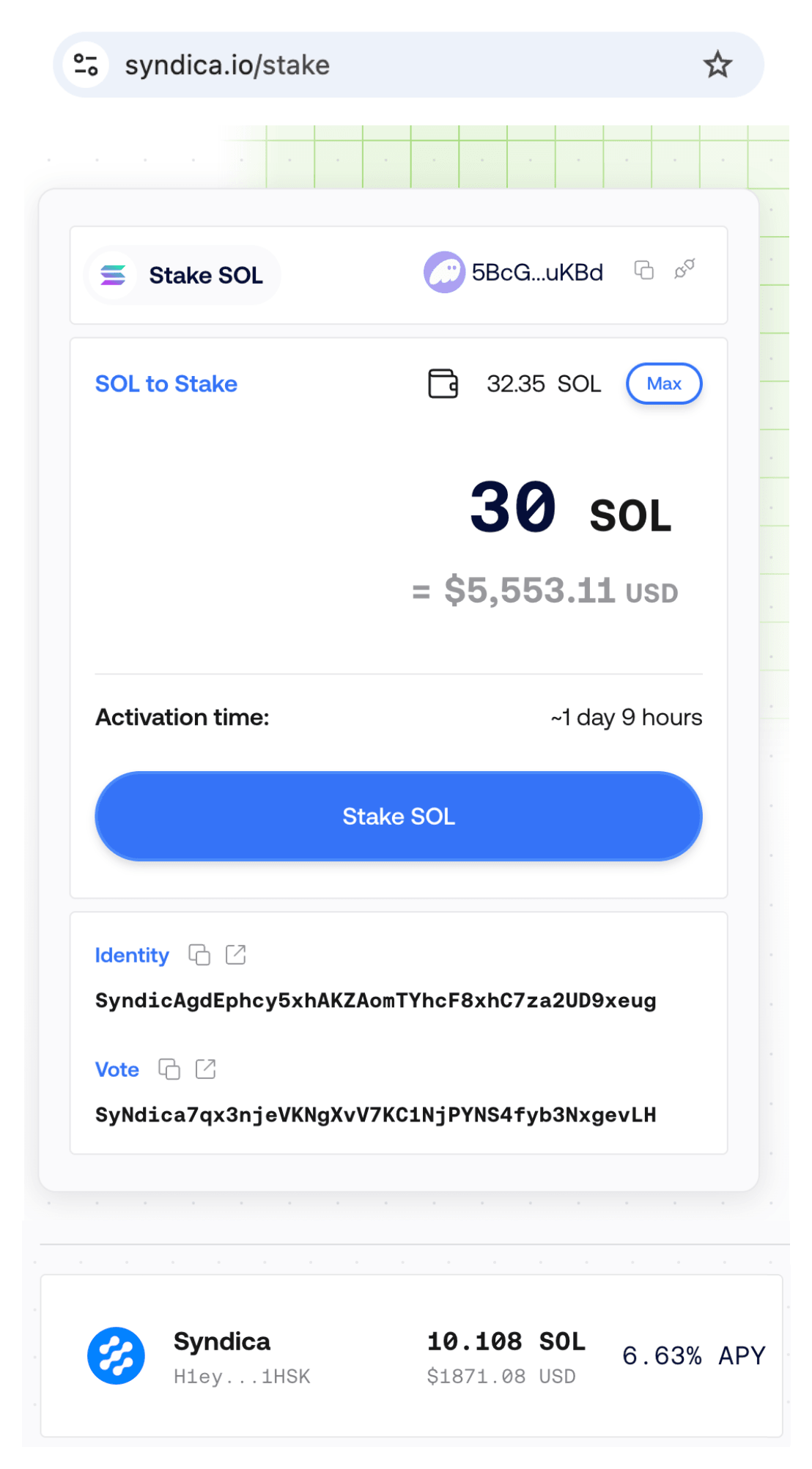
Syndica operates a high-performance validator delivering competitive staking rewards. We combine deep expertise in both Solana infrastructure operations and validator development—we're the creators of Sig, a new Solana validator client. We implement data-driven upgrades backed by our own research and experience building the most fault-tolerant systems in the Solana ecosystem, and consistently deliver maximum returns to our delegators.
Key Benefits:
- 0% commission on inflation + MEV rewards
- Jito-Solana client for enhanced returns
- 100% uptime with 0 skipped slots
- Self-custody: your SOL remains under your control
- Transparent performance metrics on public dashboards
Use our dedicated Stake application to easily stake with Syndica. Simply connect your wallet to create and manage your stake accounts.
FAQ and Troubleshooting
Find answers to commonly asked questions about the Syndica platform. See the full FAQ for more details.
What's included in the Standard (free) tier, and is it still free if I add a credit card?
The Standard (free) tier includes 10 million requests per month, up to 100 requests per second (RPS), and 100 GB of data transfer. Adding a credit card does not change your plan or start billing; it only enables instant upgrades later. The Standard plan remains free.
Which Solana networks does Syndica support?
Syndica supports Solana mainnet-beta and devnet.
- HTTP endpoints:
- Mainnet-beta:
https://solana-mainnet.api.syndica.io/api-key/YOUR_API_KEY - Devnet:
https://solana-devnet.api.syndica.io/api-key/YOUR_API_KEY
- Mainnet-beta:
- WebSocket endpoints:
- Mainnet-beta:
wss://solana-mainnet.api.syndica.io/api-key/YOUR_API_KEY - Devnet:
wss://solana-devnet.api.syndica.io/api-key/YOUR_API_KEY
- Mainnet-beta:
Requests automatically route to the nearest healthy edge in four regions: us-east-1 (N. Virginia),
us-west-2 (Oregon), eu-west-2 (London), ap-southeast-1 (Singapore).
Which regions does Syndica support?
Syndica currently deploys Edge Gateways in four regions so requests stay close to your users:
Northern Virginia (us-east-1), Oregon (us-west-2), London (eu-west-2), and Singapore
(ap-southeast-1). Each request is automatically routed to the nearest healthy region; contact
support if you need access to additional geographies.
How do I know if I'm hitting rate limits?
Rate limit responses return HTTP 429 status codes. You can monitor your usage in the RPC Analytics dashboard. See Observability to learn how to inspect logs and metrics when diagnosing throttling, review Rate Limits and plans/pricing for plan-specific limits, or configure custom rate limits per API key.
Which authentication method should I use?
Both methods work identically—choose based on your use case:
- URL-embedded is simpler for testing with tools like cURL or Postman.
- Header-embedded keeps your key out of URL paths, which may be preferable for logging and monitoring systems.
Can I use the same API key for both mainnet and devnet?
Can I use Syndica with Solana web3.js or other SDKs?
Absolutely. Syndica works with any Solana client library. Use your Syndica endpoint URL when creating the connection:
import { Connection } from '@solana/web3.js'

const connection = new Connection('https://solana-mainnet.api.syndica.io/api-key/YOUR_API_KEY')
How does Syndica help me manage my infrastructure?
Running your own node usually means provisioning, hardening, and wiring together load balancing, caching, access controls, monitoring, and failover before you can ship. With Syndica, you point your client at a managed endpoint and start building—sensible defaults provide routing, resiliency, and visibility out of the box. The result is a quicker path to production with less infrastructure to build and maintain.
What makes Syndica's RPC faster than running my own node?
Requests pass through a global edge with regional caches for frequently accessed Solana data, reducing trips to validators. Cache misses are handled by a managed validator cluster with redundancy and automatic failover. This design typically results in lower and more consistent latency than operating a single node.
Support
Need help? Our team is here to assist you through multiple channels:
Platform Customer Support
Submit a support request through the
Product Support form in your Syndica dashboard
Email
Reach us directly at support@syndica.io
Discord
Join our community for discussions and support on Discord